
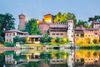
10 Things to Do in Turin on a Small Budget
What are the Cheap Things to Do in Turin?
We’ve compiled this guide of things to do in Turin on a small budget for shoestring travellers looking to enjoy the best of the Italian city. Turin‘s historic centre is very easy to explore on foot, so you can explore its ornate Baroque architecture and grand piazzas.
The city has around 18 km of covered walkways, along with elegant arcades housing cafes and boutiques. You can also explore historic buildings dating back to the 15th century, many of which are free to enter – proofs that holidays in Turin don’t have to be expensive.
1. Royal Library of Turin
A UNESCO World Heritage site with charming codices and gorgeous designs

适合: 经济
The Royal Library of Turin was founded by Carlo Alberto in 1831 to expand his book collection, which comprised volumes from antique dealers across Europe. You can find it on the ground floor of the Royal Palace of Turin.
Along with over 200,000 titles, the library contains drawings by famous artists from the 15th to 17th centuries, including Raphael, Michelangelo, Rembrandt, and da Vinci. The Royal Library of Turin is part of the Musei Reali (Royal Museums) complex, which requires an entry fee. However, you can peruse the reading room for free – its decorated vaults are lined with elegant wooden shelves.
地址: Piazza Castello, 191, 10122 Torino TO, Italy
开放时间 Monday–Friday from 8.15 am to 6.45 pm, Saturday from 8.15 am to 1.45 pm(closed on Sundays)
电话: +39 011 1921 1630

Royal Library of Turin
2. Devil’s Door
An iconic place surrounded by mystery and legends
适合: 照片, 经济
The Devil’s Door (Portone del Diavolo) is a mysterious landmark dating back to 1850. Located on Via XX Settembre in Turin, it’s a beautiful door with carvings of flowers and animals, with a knocker that depicts a demon with 2 snakes in its jaws.
This sparked popular imagination and inspired myths and legends, from a ghost who supposedly haunts the building to skeletons hidden in the walls. The Devil’s Door is part of a building that served as a tarots factory (it’s now Banca Nazionale del Lavoro).
地址: Via Vittorio Alfieri, 5, 10121 Torino TO, Italy
Devil’s Door
3. Villaggio Leumann
A 19th-century industrial village in Collegno
适合: 历史, 照片, 经济
Villaggio Leumann is a historic neighbourhood in Collegno, about 16 km east of Turin. It’s a great place to step back in time, as the village has Liberty-style architecture, a vintage train station, and a church with different architectural styles.
Villaggio Leumann was built between the late 19th and early 20th centuries by a Swiss entrepreneur, Napoleon Leumann. The picturesque buildings are still inhabited, so it feels you’re inside a living museum.
地址: Villaggio Leumann, 10093 Collegno, Italy
Villaggio Leumann
4. Fetta di Polenta
A bizarre building by Alessandro Antonelli
适合: 照片, 经济
Fetta di Polenta is a yellow and triangular structure in Turin’s Vanchiglia district. Formally known as Casa Scaccabarozzi, it’s the work of Alessandro Antonelli, who also designed the Mole Antonelliana in the 1860s.
You can easily spot Fetta di Polenta, thanks to its incredibly narrow shape – the front is over 5 metres wide, but the back is just 54 cm wide. For years it was occupied by Antonelli and his wife Francesca Scaccabarozzi, which gave the building its official name.
地址: Via Giulia di Barolo, 9, 10124 Torino TO, Italy
Fetta di Polenta
5. Fontana Angelica
A popular meeting point in Turin
适合: 历史, 照片, 经济
Fontana Angelica (Angelic Fountain) is a historic monument and meeting point on the northern edge of Piazza Solferino. It was built in 1929 to honour the will of the minister Bajnotti, who left 150,000 lira to construct a monument to his parents. Art lovers can admire Giovanni Riva’s beautiful sculptures, which represent the 4 seasons.
Those interested in Masonic symbolism can appreciate the figures’ obscurer significance. The females represent the virtue and vice of love, while the males guard the Pillars of Hercules, watching over the way to knowledge, depicted by the water flowing from their wineskins. From a certain distance, you’ll notice the sculptures form a perfect rectangle.
地址: Piazza Solferino, 10121 Torino TO, Italy
Fontana Angelica
6. Cappella dei Mercanti
A Catholic church containing the famous Perpetual Calendar
适合: 历史, 照片, 经济
Cappella dei Mercanti dates back to the 16th century, displaying many artworks and artefacts from the 17th and 18th centuries. This baroque masterpiece was built for a congregation that worked in finance and commerce.
It contains 11 frescoes of the Nativity and the Epiphany, which date back to the 1700s, as well as a wooden organ in its marble altar. Cappella dei Mercanti is most famous for housing Giovanni Plana’s Perpetual Calendar, one of the world’s oldest calculator machines. It calculates the exact time for 4,000 years, starting from year 0.
地址: Via Giuseppe Garibaldi, 25, 10122 Torino TO, Italy
开放时间 Tuesday, Thursday and Saturday from 3 pm to 6 pm, Sunday from 10 am to noon
电话: +39 011 562 7226
Cappella dei Mercanti
7. Basilica of Superga
A baroque basilica with expansive alpine views
适合: 家庭, 历史, 照片, 经济
The Basilica of Superga is an 18th-century landmark by Filippo Juvarrais. The hilltop structure features late Baroque-Classicism architecture, while its dome has similar elements with Michelangelo’s dome at St. Peter’s Basilica.
Climb 131 steps up a spiral staircase and you’ll end up on the dome’s outer balcony. Entrance to the Basilica of Superga is free, but going up the dome costs a few euros. To reach Superga Hill’s summit, you can take a historic tramway from Borgo Sassi station, or tackle a 1.5-hour-long nature trail for free.
地址: Strada Basilica di Superga, 73, 10132 Torino TO, Italy
开放时间 Summer: Friday to Sunday from 10.30 am to 1 pm and from 3 pm to 6 pm. Winter: Thursday–Tuesday from 9.30 am to 1 pm and from 2.30 pm to 5 pm (closed on Wednesdays)
电话: +39 011 899 7456
Basilica of Superga
8. Covered passages of Turin
Great examples of Italy’s Art Nouveau architecture movement
适合: 照片, 经济
The 3 covered passages of Turin are among the city’s most iconic features, dating back between the late 19th and early 20th centuries. The glass-covered walkways allow people to move between the centre’s buildings during bad weather, housing plenty of shops, cafes and cinemas.
Galleria San Federico near Piazza San Carlo is one of the largest and busiest covered passages in Turin. A little further, towards Piazza Castello, is Galleria Subalpina, which is famous for its massive glass roof. Walk for about 1 km towards Porta Palazzo to get to Galleria Umberto I, where you can grab a bite at Caffè della Basilica.
Covered passages of Turin
9. Church of Santa Maria al Monte dei Cappuccini
Enjoy expansive views of Turin, the Alps and the River Po
适合: 历史, 照片, 经济
A stroll to the Church of Santa Maria al Monte dei Cappuccini results in expansive views of Turin and the Alps. The Renaissance-style church was built in 1584, with a layout that resembles a Greek cross and crowned by a white and grey dome.
Church of Santa Maria al Monte dei Cappuccini contains the body of Saint Ignatius of Santhià. After visiting the church, you can explore its surroundings, which overlook the River Po.
地址: Piazzale Monte dei Cappuccini, 3, 10131 Torino TO, Italy
开放时间 Daily from 7 am to 7 pm
电话: +39 011 660 4414
Church of Santa Maria al Monte dei Cappuccini
10. Borgo Medievale
A medieval village in Parco del Valentino
适合: 家庭, 照片, 经济
Borgo Medievale is a life-sized model of a medieval village in Parco del Valentino. It adds a rather whimsical touch to the public park, giving you a glimpse of life in the 1300s. Built in 1884 to host the Turin Fair, the village’s quirky architecture was inspired by Piedmont palaces and castles.
Borgo Medievale is one of Turin’s most photo spots. There are many shops selling handicrafts and local food. You can even see local artists at work, using metal and paper to create unique works.
地址: Viale Virgilio, 107, 10126 Torino TO, Italy
开放时间 Daily from 9 am to 7 pm
电话: +39 011 443 1702
Borgo Medievale
本文包含 Go Guides 编辑团队的意见。Hotels.com 好订网对作者出现在本网站上的文章给予补偿;此类补偿可能包括差旅费和其他费用。